
Prometheus Fuels lights the fire for SAF

In the myth of Prometheus, the Titan, after creating mankind at Zeus’ request was not content. He decided humans needed fire in order to discover new things. Prometheus decided to take a spark from the fireplace of Olympus and give it to humans on earth. He saw fire as essential for humans to build, to eat, to dare to think and to take risks.
The same fire inspired California-based environmental engineering PhD Rob McGinnis to found Prometheus Fuels to turn electricity from solar and wind into sustainable aviation fuel (SAF).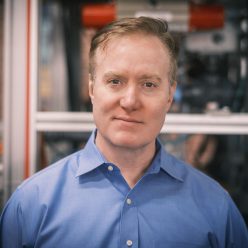
“The Greek myth of Prometheus is about introducing fire to humanity, and fire is a metaphor for transformative new technology. We felt that what we’re doing is significant enough to warrant that association,” he tells SAF Investor when asked about why he chose the name.
The startup graduated the Y Combinator in 2019. Its Series A was led by BMW and its Series B, by Maersk. But Covid delayed initial timelines. Since then, McGinnis says they have delivered on everything they committed to.
“We’ve just completed a year of pilot-scale operation. Our methanol is at TRL 9. Our SAF is closer to TRL 6 – it’s on full-size equipment but at prototype production quantities,” he tells us. Staying true to the Promethean myth, McGinnis called its production module Titan Forge Alpha – but it was made out of plastic.
“Inside that system [Titan Forge], we’ve figured out how to take electricity from our solar arrays and convert the carbonate and water directly into kerosene – at atmospheric pressure and room temperature. That has long been considered a holy grail of electrochemistry. It’s something academics have been pursuing for decades,” McGinnis tells us.
“In continuous operation, the CO2 is absorbed from air as carbonate, converted into kerosene, which rises to the surface of the water and can simply be skimmed off. The output is a finished SAF: a synthetic paraffinic kerosene, chemically very similar to other synthetic paraffinic kerosenes that already have ASTM pathways.”
But McGinnis highlights he needs to stress that this is not “simply a repackaging of existing technologies” but “rather something genuinely new.” They don’t use CO2 or hydrogen to make their fuel, nor do they use Fischer-Tropsch. “The process is 100% electrochemical – no pressurised reactions, no conventional processes at all.”
And this is where Prometheus is unbound. Without the need to convert CO2 into CO2 gas, Prometheus can significantly cut capital expenditure. With a plastic stack, a cooling tower and a direct air capture (DAC) structure, McGinnis claims they can develop a stack capable of producing 500 gallons of SAF per annum at a capex of $10,000 which can theoretically operate for 20-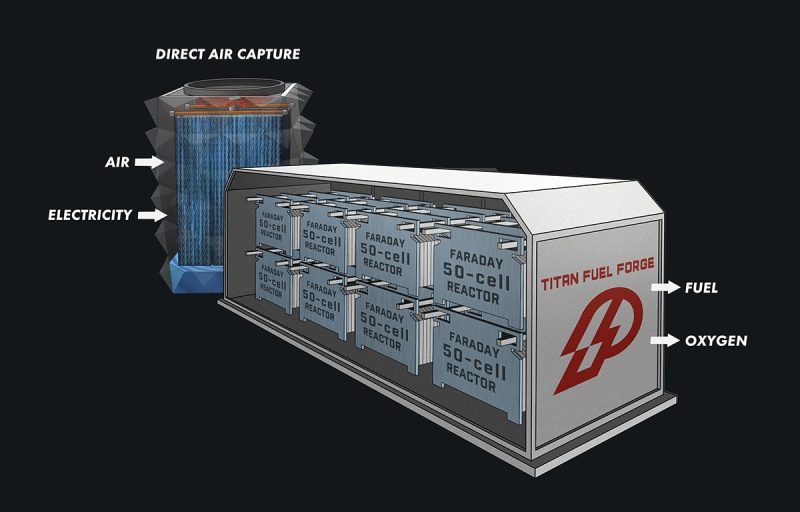 25 years.
“It is a brand new pathway, designed from scratch. If you are running a hot, high-pressure process like Fischer-Tropsch, you have to run it 24/7, which means a grid connection, which means expensive power,” he says. “We operate at atmospheric pressure and room temperature, with everything made from plastic.”
This means the company’s stack can produce SAF when the sun is shining and can shut down at night. The company also touts its modular approach as the key to delivering at scale. That means something the size of a refrigerator can produce SAF at the same price per gallon as something the size of an industrial park. “Our modular, linearly scalable solution means you can produce SAF on a remote island, powered by your own solar array and it would still be economical,” he claims.
The technology is modular, requires low Capex and low opex. So what’s next for Prometheus? “We want to begin our first commercial-scale project this year. After a year of pilot-scale operations, we are now in the process of selecting a site. We expect to start in the US and are in active conversations with various states about the best location,” he tells us.
But that’s not the only approach Prometheus is taking. McGinnis says in addition to building their own production pipeline, they will also market their containerised solutions around the world.
“We have opened our Series C and are currently fundraising,” says McGinnis. Fortunately, due to linear cost scaling, a first-of-a-kind plant only requires around $5m. That’s a fundamentally different proposition from raising a billion dollars for a facility that uses Fischer-Tropsch.
The company plans to begin the application process this year scaling from a single cell to multiple cells. McGinnis says once their facility starts producing enough fuel, the data will be sent to ASTM for fast track approval on the new pathway. “We also have an existing offtake LOI with American Airlines, announced in 2021, which gives us a potential launch customer. It’s non-exclusive, so we can supply other airlines as well,” he tells us.
While the initial plans focus on the US, McGinnis says they plan to expand into the European market. “We intend to supply SAF to Europe as well. The first project will be in the United States, but we can replicate that in Europe,” he explains.
For the eSAF industry which continues to wait for its breakthrough moment, Prometheus Fuels may have just found the spark.
Subscribe to our free newsletter
For more opinions from SAF Investor, subscribe to our email newsletter.