
Twelve ties up capital
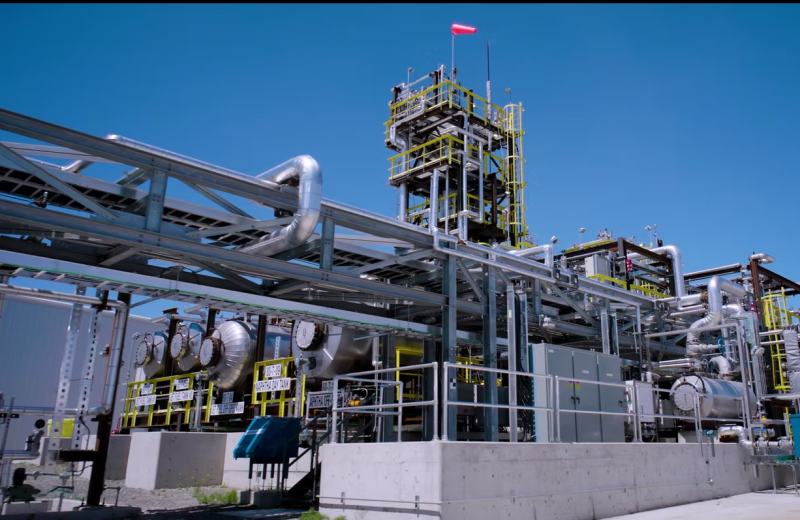
Twelve announced it has refinanced that $45m construction loan into an operating credit facility.
Climbers choose their rope by the fall they expect to take. A static rope is good when abseiling, but a lead climber ascending into the unknown needs a dynamic rope to catch a big fall.
It is a similar story with capital investment. Different forms of capital absorb different kinds of risks.
Senior debt absorbs revenue dips by relying on secured collateral. Venture capital shoulders the possibility of total business model failure in exchange for high upside potential. Consequently, projects launching first-of-a-kind (FOAK) technologies with low technology readiness levels (TRLs) carry higher risks and have to pay premium when raising funds.
Twelve, the US-based producer of power-to-liquid sustainable aviation fuel (SAF), is building a FOAK project in the US. In September 2024, it raised $645m which included $400m in project equity led by TPG Rise Climate, $200m Series C equity round and an additional $45m in credit facilities.
For Twelve, this financing absorbed risk in layers. The Series C financing backstopped the enterprise-level bets on the technology and business model while TPG’s project equity absorbed scale-up risk. Meanwhile, the $45m construction loan for the company’s AirPlant One site in Moses Lake, Washington, absorbed construction risk.
Recently, Twelve announced it has refinanced that $45m construction loan into an operating credit facility. Nomura and Endurance Capital served as lenders for the deal, acting as joint bookrunners, with Nomura also serving as administrative agent.
“AirPlant One is producing on-spec E-Jet SAF and E-Naphtha, which materially changes the financing conversation,” Ashwin Jadhav, vice president of Business Development at Twelve
Ashwin Jadhav
tells us.
From risk profile point of view, the construction risk was replaced with operating risk which is inherently cheaper and easier for lenders to underwrite.
“Moving from construction into commercial operation substantially changes the project’s risk profile. The plant’s operating history, production of on-spec products and demonstrated commercial demand allowed us to access a financing structure appropriate for a de-risked operating asset,” he adds.
Jadhav noted that reaching commercial operation was an “important inflection point.” Because it allows potential investors to evaluate an operating asset rather than a construction-stage project or technology concept.
“Twelve has proven power-to-liquid works at commercial scale; this financing is about funding what’s next. We’re pleased to partner with Endurance Capital to back Twelve as it scales the technology that’s decarbonising aviation fuel,” said Alain Halimi, managing director for IPB at Nomura in a press release following the refinancing announcement.
Offtake agreements for both eSAF (E-Jet) and e-naphtha supported the underwriting but Jadhav emphasised the exercise was not carried solely by these contracts.
“Customer commitments and visible demand for both E-Jet SAF and E-Naphtha were important indicators of commercial viability,” he says. “However, lenders do not underwrite an asset based on one factor or one contract. Their review included the plant’s operating performance, technology, product specifications, commercial arrangements, input supply, expansion plans and the overall financial structure.”
While Jadhav didn’t disclose the interest rate delta, underwriting terms or diligence timelines, he acknowledged the process was: “comprehensive, as would be expected for a first-of-its-kind commercial Power-to-Liquid facility.”
In a press release, Yoni Ophir, Endurance Capital’s CEO said the deal with Twelve represents the kind of investment their fund intends to make. “Twelve has established itself as a leader in power-to-liquid fuels and represents exactly the type of company Endurance was built to support,” he said.
Sitting alongside the $400m project equity commitment, the refinancing raises questions about what capital structure Twelve intends to pursue going forward.
“We have not established a single public debt-to-equity target for future AirPlants,” he tells us. “The appropriate capital structure will be project-specific and will depend on factors such as contracted revenues, plant scale, operating and technology risk, applicable incentives, electricity and CO2 supply arrangements, construction risk and prevailing financing conditions.”
Jadhav says the objective is “the most efficient mix of project equity, debt and other non-dilutive capital while maintaining a prudent risk profile,” with the expectation that “the universe of available infrastructure and project-finance capital” will keep expanding as later plants benefit from repeatable design.
The refinancing at Twelve shows how operational progress can translate into access to institutional debt capital.
“It provides capital for the next phase of growth at Moses Lake, including expanded hydrogen-production capability, while establishing an important precedent for financing power-to-liquid infrastructure. For Twelve, it is another step in turning AirPlant from a first commercial facility into a scalable industrial platform,” Jadhav tells us.
Risks are never static. Just ask an alpinist. They move from concept to execution. The cost of capital also moves accordingly. By proving its technology works, Twelve derisked its AirPlant One facility allowing institutional debt to take over the risk carried by equity.
Subscribe to our free newsletter
For more opinions from SAF Investor, subscribe to our email newsletter.