
KBR review backs Syntholene’s geothermal hydrogen economics for eSAF production
Syntholene Energy has received an independent technical and economic review of its geothermal-integrated hydrogen production platform, assessing its potential application to low-carbon fuels including synthetic sustainable aviation fuel (eSAF).
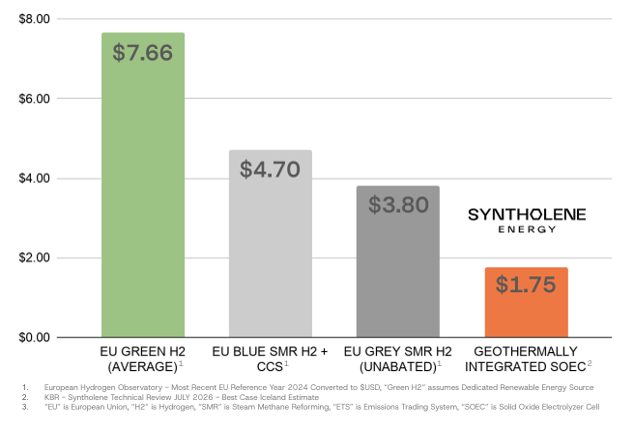
Kellogg Brown and Root (KBR) was engaged to review the technical basis and cost methodology behind Syntholene’s hydrogen technology. The review assessed the company’s levelized cost of hydrogen (LCOH) approach and ran sensitivity analysis across key cost variables, concluding a likely LCOH of around $1.75/kg H2 under best-case Iceland geothermal conditions, rising to around $2.10/kg H2 under broader deployment.
Hydrogen is the dominant cost driver in synthetic aviation fuel production, making low-cost generation central to cost-competitive eSAF. Syntholene’s target compares favourably with recent unsubsidised green hydrogen benchmarks in Europe, which have averaged around $7.66/kg H2, and even undercuts the regional benchmark for unabated fossil hydrogen produced via steam methane reforming (SMR), estimated at around $3.80/kg H2 — rising to roughly $4.70/kg H2 once carbon pricing is factored in.
The review noted that successful operation at Syntholene’s demonstration facility in Húsavík, Iceland, would generate key operating data on efficiency, thermal integration, reliability and stack degradation.
“Syntholene’s core thesis is that low-cost synthetic fuel production starts with low-cost clean hydrogen, and that the lowest-cost clean hydrogen will come from systems that intelligently use both electricity and heat,” said Dan Sutton, CEO, Syntholene Energy. “The report identifies the major cost drivers, validates the importance of our now-operating Húsavík Demonstration Facility, and reinforces why geothermal colocation can be a structural advantage in synthetic fuel production.”
The findings rest on a number of assumptions rather than commercial operating data, including advantaged geothermal access and successful thermal integration. The LCOH estimate is based on a 1,200 kW system with $1.2 million in capital expenditure and an assumed electricity price of $30/MWh. KBR flagged several risk factors, including electricity price variability, long-duration SOEC degradation, stack life assumptions, and validation of project-specific capital and operating costs.
The review identified a number of potential differentiators for Syntholene, including its use of low-carbon geothermal electricity and heat, reduced electrical intensity through SOEC operation and heat recovery, integration advantages for eSAF configurations, mitigation approaches for geothermal silica scaling, and a dynamic AC:DC operating strategy intended to extend SOEC stack life.