
Twelve opens first commercial scale eSAF facility in the US, AirPlant One.
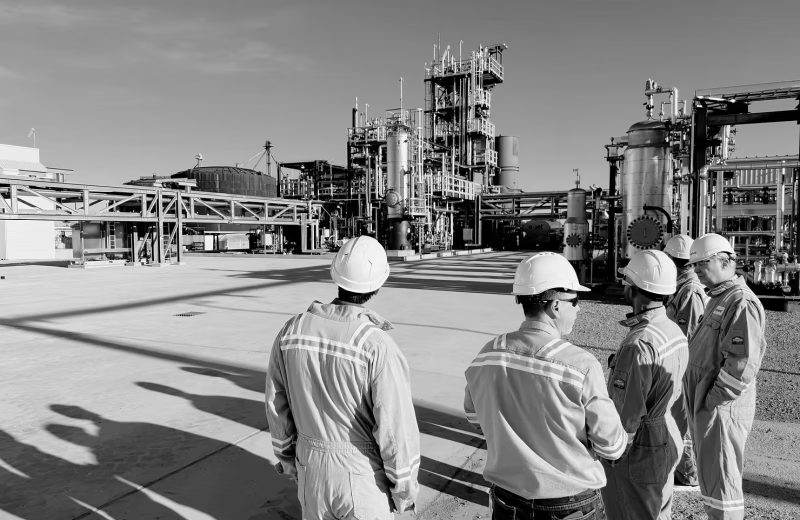
Power-to-liquid (PtL) sustainable aviation fuel (SAF) developer Twelve has opened AirPlant One, the first commercial-scale facility in the United States producing eSAF from CO2 and renewable electricity, at Moses Lake, Washington.
The facility produces eSAF, a drop-in synthetic jet fuel that requires no modifications to aircraft, engines, or airport infrastructure as well as E-Naphtha, a CO2-derived chemical building block for use in plastics, packaging, and other everyday products.
“We broke ground on AirPlant One with a simple thesis: that the fuels powering the global economy could be made from renewable electricity and air, anywhere in the world,” said Nicholas Flanders, co-founder and CEO, Twelve. “Today, that thesis is operational.”
Unlike bio-based pathways such as HEFA, which depend on agricultural feedstocks subject to land and supply constraints, Twelve’s eManufacturing process uses an electrolyser to convert captured CO2, water, and renewable electricity into hydrocarbon fuel molecules, in the form of syngas. Technology partner Emerging Fuels Technology (EFT) licensed their Fischer Tropsch (FT) synthesis and Maxx Jet upgrading technologies to Twelve to convert the company’s syngas into drop-in jet fuel.
“For years, e-SAF has lived on slides. Seeing our Fischer-Tropsch and upgrading technology turn CO₂-derived syngas into finished jet fuel at Moses Lake is the moment it becomes a product. We’re proud that Twelve built what they’re calling the first commercial e-SAF plant in the US around EFT’s technology,” comments Mark Agee, VP licensing and business development, Emerging Fuels Technology.
Twelve and EFT initially tested their technologies together as an end-to-end pilot demonstrators at the EFT headquarters in Tulsa late in 2025.
The first phase project scale will be between 40,000-50,000 gallons per year.
Alaska Airlines, which backed Twelve’s $645m funding round through its Alaska Star Ventures arm, will operate regular domestic flights on eSAF produced at the facility. Microsoft, which provided investment via its Climate Innovation Fund alongside a SAF offtake agreement, will use a book-and-claim accounting model to attribute emissions reductions from business travel.
“As Seattle’s hometown airline, we are committed to supporting in-state production of sustainable aviation fuel, which is currently the best technology for the airline industry to reach net-zero carbon emissions,” said Ryan Spies, MD of sustainability, Alaska Airlines. “Our partnership with Twelve and Microsoft demonstrates the power of innovation and collaboration to successfully advance SAF, while creating new jobs, diversifying fuel supply chains and strengthening energy security.”
“Climate progress depends on collaborations that send signals to investors and innovators to move markets,” said Melanie Nakagawa, CVP and chief sustainability officer, Microsoft. “Our investment in Twelve helps scale energy solutions while laying the groundwork for cleaner aviation at a global scale. We look forward to sourcing future gallons of Washington-produced SAF to help reduce our business travel emissions.”